The Fresh Start Effect: Why Tomorrow Really Is a Clean Page

By Ray Chooi · Founder of TaskGrower ·
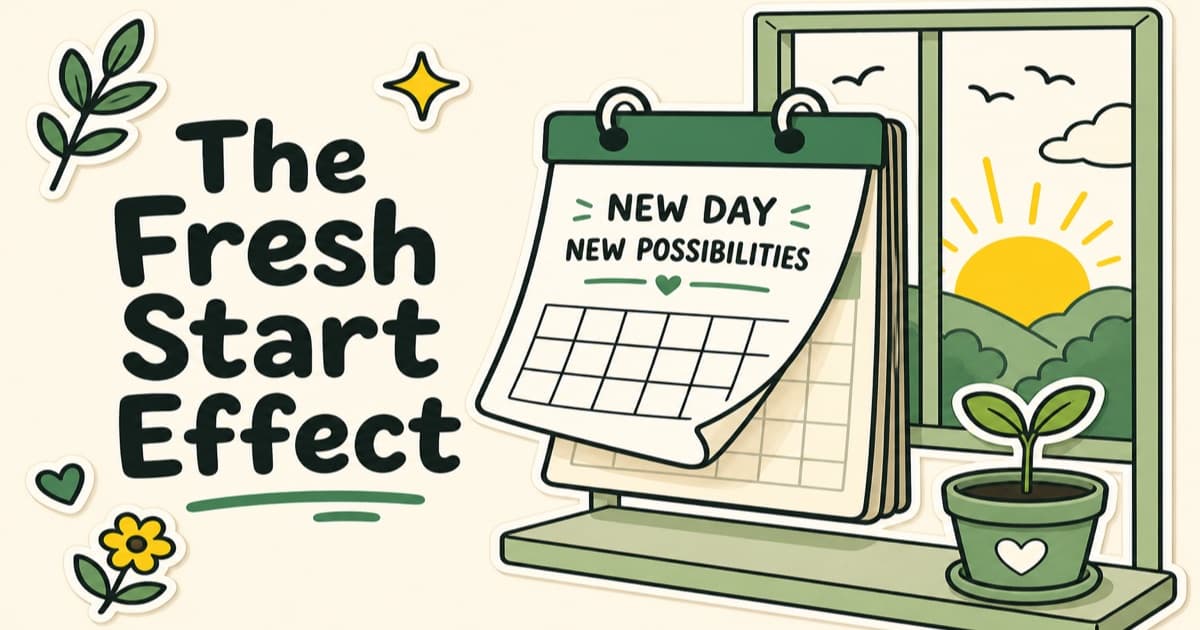
Some days do not go how you planned. The interesting question is what that costs you. For a lot of people, one bad Tuesday writes off the week. Psychology says it does not have to. The reason is built into the calendar.
Landmarks reset the ledger
In 2014, researchers at Wharton noticed a pattern. Katy Milkman led the work. Hengchen Dai and Jason Riis co-authored it. Gym attendance jumps at the start of a new week. Also a new month. A new semester. Just after birthdays. Searches for "diet" spike on Mondays. Commitment contracts get signed after landmarks. They named it the fresh start effect.
The mechanism is bookkeeping. Your brain files life into chapters. A temporal landmark closes the old chapter. A new morning. A new week. The version of you who skipped the gym belongs to the last chapter. So does the one who ignored the report. The new one starts at zero. That sounds like self-deception. But it works. It removes the real obstacle. The feeling that today is already ruined. So why bother.
The fresh start effect is why "I'll start Monday" is not always procrastination. Sometimes your brain picks the cheapest moment to begin. The trick is to make the landmarks frequent. So a reset is never more than a sleep away.
How to build fresh starts into any task system
- Plan in days, not in one endless list. A single master list has no chapters. A bad stretch just accumulates. Day-sized lists mean every morning opens a clean page.
- Close bad days on purpose. When a day collapses, spend two minutes. Move what still matters to tomorrow. Let the rest of the wreckage stay in the old chapter. This pairs perfectly with an evening planning routine.
- Use weeks as the bigger reset. Look back once a week. Then re-plan. That gives you a second, larger landmark. Useful when a whole week went sideways. Not just a day.
- Never let one miss become a policy. The dangerous thought is not "today went badly". It is "I fell off for good". Landmarks exist to interrupt exactly that story. If a broken streak is the trigger, read coming back after breaking a streak.
How TaskGrower bakes it in
The fresh start effect is why TaskGrower runs on days and weeks. Not one infinite list.
- Every day is its own page. Tasks land on real days. Each day grows its own little scene. Yesterday's smaller tree stays in yesterday. Today starts with fresh soil.
- Two days look better side by side. Flip to week view. A rough Tuesday sits next to a good Wednesday. That reads as "a dip". Not "a failure". Context is kind.
- No streak to protect. There is no chain to break. No red badge waiting after a bad day. A quiet day just means a smaller tree. Tomorrow is a fresh one.
The quest for this idea is called "Déjà Grew". Grow a tree on two different days. Then zoom out and look at them side by side. It is a small demonstration that the page really does turn.